
Understanding Keys Unlocks Music
Follow the Fretboard Toolbox™ Path and see how chords, scales, and keys all fit together, so you can start unlocking The Music Theory That Matters Most™!
Why I Built Fretboard Toolboxes…
Since I started playing, my dream has been to sit in jam sessions like this one with my friends…
and figure out songs on the fly. I’m the one with my guitar on the left, holding on for dear life! LOL

But for so many years I felt stuck…
I could play chords.
I could play songs.
I knew some scales.
I could memorize shapes…
but I couldn’t connect the ideas behind them.I could play in a jam session…
but only if I had the chords in front of me.If someone said, "this song is in G…”
I had no idea what that meant.Figuring out chord progressions by ear felt impossible.
Improvising seemed like a far off dream.
The fretboard still felt blurry instead of connected.
I knew lots of pieces of the puzzle…
but had no idea how they fit together.
Even though I have no formal music training, I’m a big-picture person and I’m also really stubborn when I don’t get something, and so I devoted more time that I could ever remember to dissecting the secrets of keys. Pretty soon I started seeing that so much of music is predictable, and then I was blown away when I learned that these rules were all the same regardless of the instrument! As I learned more and more, eventually learning new songs, and even new instruments, became as easy as seeing these same musical ideas in the unique places they live on each fretboard.
All the information I needed was out there, but it was in 1000 different places, and, with the way my brain works, I just needed a way to see it all at once, on one page per key.
But just like every kid in chemistry class, no one gets handed a Periodic Table of Elements and thinks, "Ah, got it, I know all of science now!” Just like the Periodic Table, Fretboard Toolboxes look overwhelming at first glance, no doubt! But once someone shows you how to read the rows, columns, and numbers, it unlocks the building blocks of the ideas that help me every time that I play.
Why Two Versions?
The Complete Editions serve a purpose- visualize the most important music theory for all 14 Major, minor, and blues keys- chords, chord progressions, scales, rule-breaking notes, etc.
And the Essential Editions serve another purpose- visualize the three notes that make up Major and minor chords, along with the important scales and blues notes that matter in those keys, all over the fretboard, in the 5 keys that people play in most.
Every page packs a ton of questions that I needed answered into a single, predictable system.
Once you learn how to read a Toolbox for one key or one instrument, you can instantly see how chords, scales, and solos fit together across any key and every instrument.
I wrote them as a lifelong reference tool, not a textbook you read once and put on the shelf.
I still discover things all the time from them, over 15 years later, and I don’t see that ever stopping!
But Toolboxes definitely take some work to unlock all the things that they can help you see.
That’s why I built the Toolbox Path
You don't have to decipher the whole map all at once. I created the Toolbox Path to be your step-by-step guide to decoding these pages.
Instead of trying to swallow all of music theory whole, the Path breaks down, step-by-step, all the ideas that, to me, have been the music theory that matters most.
The Path is your free instruction guide.
The Fretboard Toolbox books are the physical, interactive tools to see that theory on your instrument.
I used to spend hours at bluegrass festivals, and in every YouTube video I made, explaining how to read my books from the ground up every time. I built this Path so you can get that exact same foundational walkthrough, at your own pace. Once you understand how the grid works, opening up new keys and entirely new instruments becomes completely intuitive, and that’s when the fun begins!
I built the Toolbox Pathfinder to help guide people through that journey. Hope it helps you!
That’s why I created Fretboard Toolboxes- to help people like me move from “put your fingers here” to creating and communicating, regardless of the instrument, by helping people see the music theory that matters most. This 20 year journey, combined with the things I’ve learned about education as a 25+ year high school science teacher, led me to build a curriculum of all the things that have helped me along the way.
Think of Toolboxes as a Periodic Table of Music
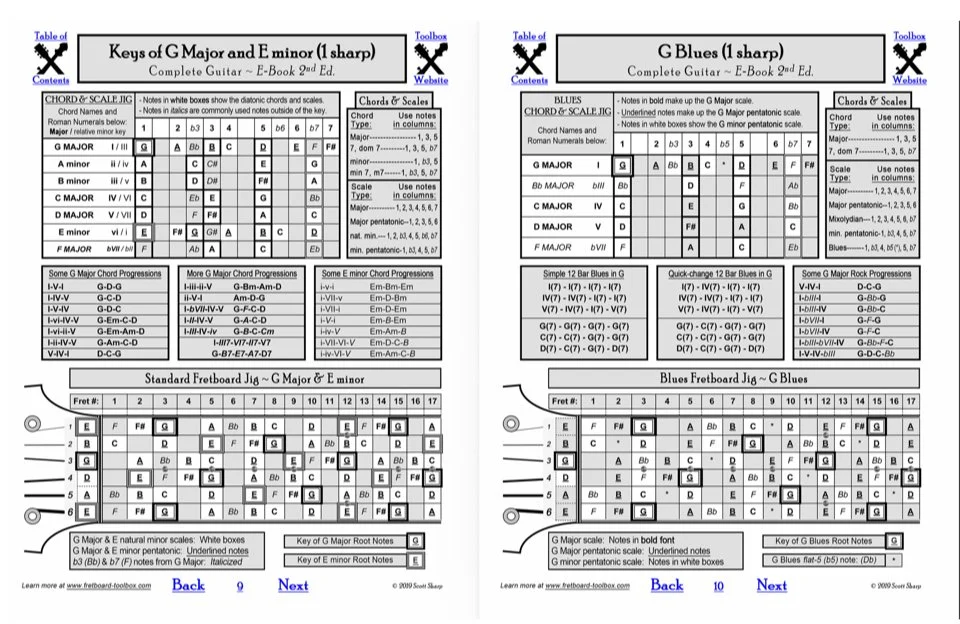
When you look at Fretboard Toolbox Complete Edition pages, they look incredibly dense, with lots of letters and boxes.
The same is true for the Essential Edition pages:
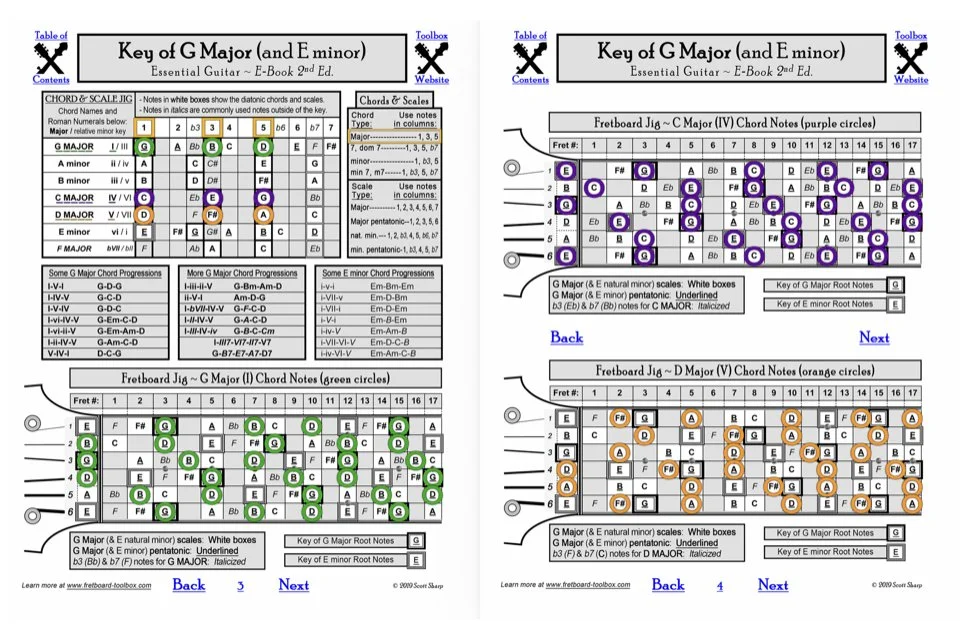
Follow the free Toolbox Path to help you to see all of these ideas,
and see if it helps you unlock some mysteries too!
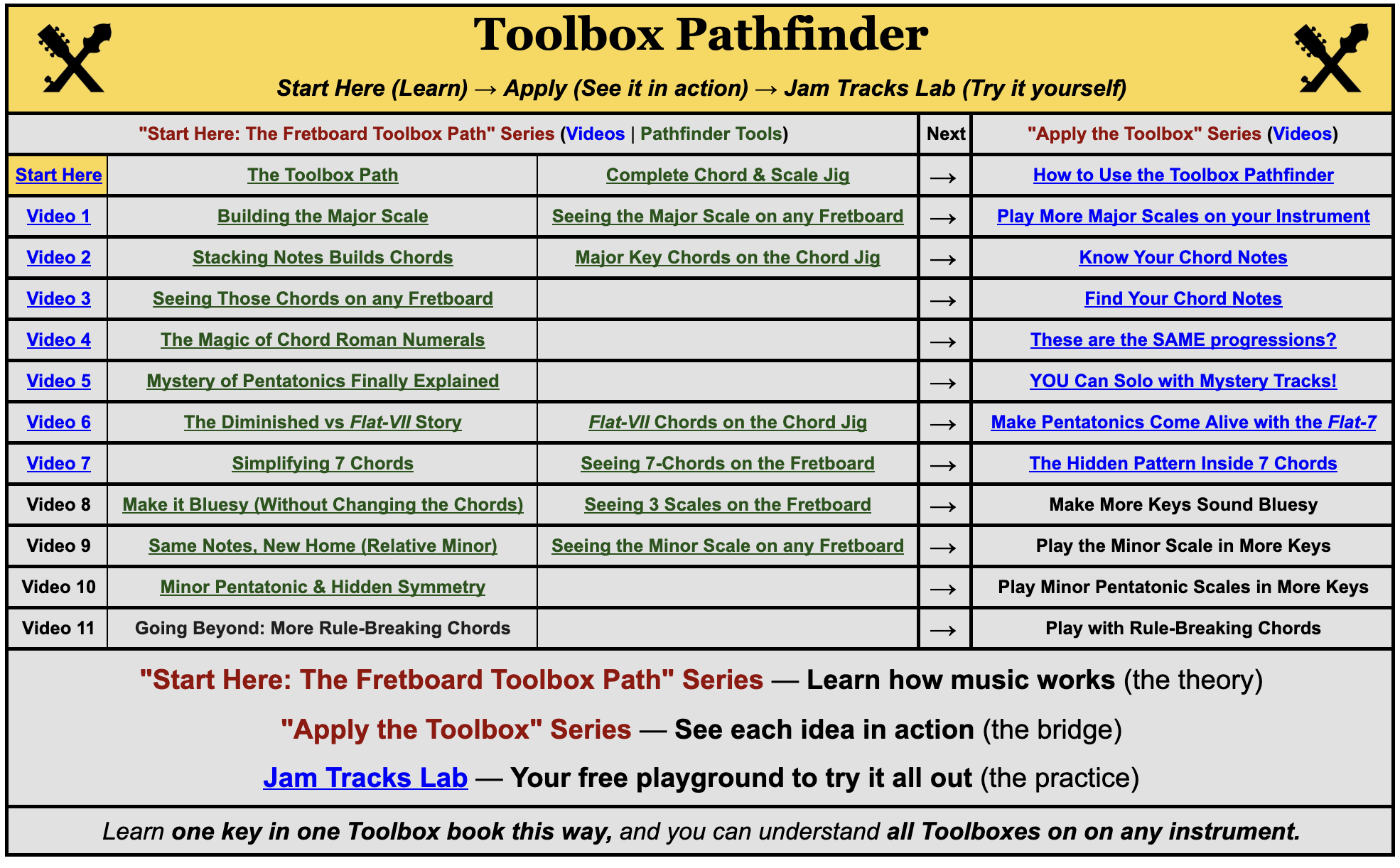
The Toolbox Path (overview)
Step 1. Learn the Major scale and discover all the doors it unlocks.
Step 3. Learn the notes that make up those chords, and find them on your instrument.
Step 2. See how the chords of a key come straight from those notes.
Step 4. Practice common chord progressions and learn their Roman numerals.
Step 6. Unlock the secrets to bluesy sounds in Major keys.
Step 5. Discover the hidden connections in pentatonic scales.
Step 7. Open up a new world of sounds with natural minor keys.
Step 8. Explore Rule-Breaking Chords (and how to use them)
There’s a chunk of music theory that holds the key to unlock the doors, and the rest bores me to tears.
That’s the chunk that Fretboard Toolboxes help you see,
in any key, on any instrument.
So figure out a couple cool things, put your music on shuffle, and start a lifetime of unlocking music!
Check out some places Toolboxes are used all over the world!